
Sha’ul’s Second Missionary Journey ~ Part 8
Note: To examine the graphics in this series, click on them for a pop-up version.
We continue our ongoing story of Sha’ul’s Second Missionary Journey beginning in Acts 17:1.
Teaching In Thessalonica
This post will be short on Scripture but long on background information that will give us a better understanding of Sha’ul’s writings.
171 After passing through Amphipolis and Apollonia, Sha’ul and Sila came to Thessalonica, where there was a synagogue. 2 According to his usual practice, Sha’ul went in, and on three Shabbats he gave them drashes from the Tanakh,
A drash or drashah is, literally, a “searching”; the word denotes a sermon, exegesis, exposition, or homiletical interpretation of a text. The typical form for a drash in the midrashic period (100 BCE to 500 CE) was: (1) introduction, consisting of a biblical verse with illustrations and parables, leading up to (2) the particular text to be explained, now expanded by stories, allegories and associations with other texts, and (3) conclusion, consisting of exhortations and words of comfort and ending with the Kaddish prayer (a prayer of praise to God used in Jewish liturgy, especially at funerals or memorial services [1]). That Sha’ul frequently used Talmudic and midrashic (an ancient commentary on the part of the Hebrew scriptures, attached to the biblical text) thought patterns are illustrated by Romans 10:5–13; 1 Corinthians 9:9–14; 2 Corinthians 3:3–18; Galatians 3:16, 4:22–31. [2]
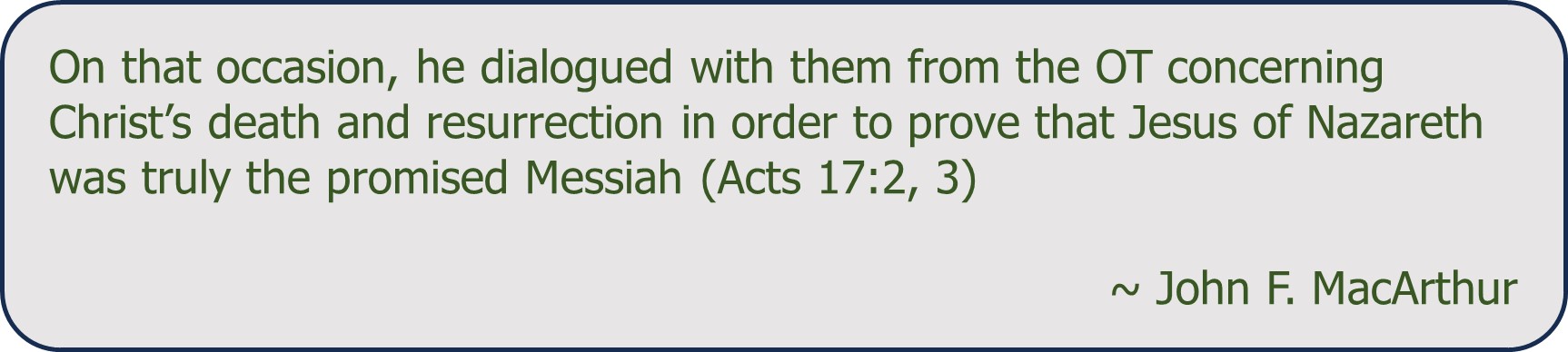
3 explaining and proving that the Messiah had to suffer and rise again from the dead and that “this Yeshua whom I am proclaiming to you is the Messiah.”
One hears opposition to “proof-texting,” which means explaining and quoting Scripture passages to prove something, just like Sha’ul. The main argument against proof-texting is that it can be misused: passages can be quoted out of context or invested with a meaning the author never intended. These are indeed abuses; “nevertheless, God’s firm foundation stands” (2 Timothy 2:19) when passages are quoted concerning context, with terms correctly translated and explained, and with account taken of the culture and background of the author and his intended readers, the method is perfectly proper. The rabbis throughout Jewish history used it, and it is reasonable to suppose that Sha’ul’s methods of using Scripture were well within Jewish tradition.
The fact that the Tanakh is cited some 695 times in the Brit Hadashah shows that its writers were convinced that although God had done something unique and radically new in Yeshua, the meaning of what he had done could be adequately expressed only with the Tanakh. This conviction set the first Believers to read the Tanakh with new eyes, which led to understanding how it relates to Brit Hadashah’s truth. For some purposes, it was sufficient to refer generally to “the Scriptures” or “the Tanakh” (e.g., 1 Corinthians 15:3–4). Still, frequently, significant events in the life of Yeshua were related to individual texts. However, one seldom finds in the Brit Hadashah the kind of far-fetched allegory common in later rabbinic and Christian interpretation, and there is rarely the kind of sustained verse-by-verse commentary on a Tanakh passage that can be found already at Qumran and later in both Jewish and Christian traditions (but Messianic Jews 3:7–4:11 has this character). In conclusion, in the Brit Hadashah, individual verses are used with restraint to express the writers’ underlying confidence that Yeshua, the Messiah’s coming, is central to fulfilling God’s purposes for Isra’el and the world.
The Messiah had to suffer and rise again from the dead. Sha’ul had to show this from the Tanakh, e.g., from Isaiah 52:13–53:12 and Psalm 16:8–11, because the Jewish people expected that the Messiah’s first and most crucial act would be political liberation.
This Yeshua … is the Messiah. The first task was to re-order Jewish expectations. The second, here, is to show that these new expectations are fulfilled in Yeshua. [3]
4 Some of the Jews were persuaded and threw in their lot with Sha’ul and Sila, as did a great many of the Greek men who were “God-fearers,” and not a few of the leading women. [4]
The expected consequence of trusting Yeshua is to remain in fellowship with those who led you to faith. Sha’ul and Sila, unlike many of today’s evangelists, never left new Believers to flounder for themselves; we are not told of new Believers who went off by themselves, eschewing the company of other Body members.
In our next post, we will continue to explore Shaul’s Second Missionary Journey; we will follow Sha’ul and Sila on their journey through Macedonia, starting in chapter 17:5.
Click here for the PDF version.
[1] Susan Gillingham, “Psalms through the Centuries: A Reception History Commentary on Psalms 1–72.”
[2] David H. Stern, Jewish New Testament Commentary.
[3] Ibid.
[4] Acts 17:1-4.
 My Heart Is For Israel