The Red-Letter Words of Yeshua ~ Part 175
The Crucifixion of Yeshua ~ Part 1
In our last post, we concluded Yeshua’s Trial Before Pilate. We now begin to explore Yeshua’s Crucifixion in this post.
Introduction
It’s sometime before noon on Friday when the procession reaches the outskirts of Yerushalayim, and the crowd gathers on a craggy hill known as Golgotha – The Skull. As Yeshua is nailed to the wooden cross and lifted up, the scene below Him becomes a strange mixture of emotions. On the one hand, He sees the bitter sorrow of His family and followers; on the other hand, He sees the carnival-like atmosphere of the soldiers and those who have demanded His death.
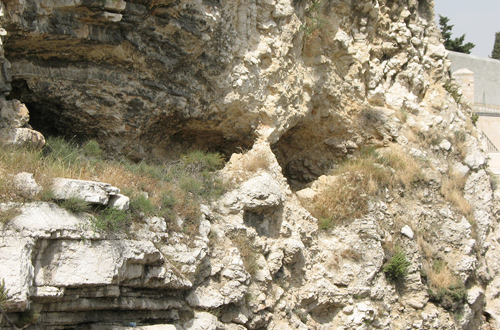
Click on the image to expand.
Yeshua Is Crucified
32 Two other men, both criminals, were led out to be executed with Him. 33 When they came to the place called The Skull, they nailed Him to a stake; and they nailed the criminals to stakes, one on the right and one on the left. 34 Yeshua said, “Father, forgive them; they don’t understand what they are doing.” 1 23 Then they gave Him wine spiced with myrrh, but He didn’t take it. 2
Wine mixed with myrrh was a primitive narcotic. The offer fulfilled Psalm 69:21 ~ They put poison in my food; in my thirst, they gave me vinegar to drink.
25 It was nine in the morning when they nailed Him to the stake. 3
Inscription On the Cross
19 Pilate also had a notice written and posted on the stake; it read,
YESHUA FROM NATZERET
THE KING OF THE JEWS
20 Many of the Judeans read this notice because the place where Yeshua was put on the stake was close to the city, and it had been written in Hebrew, Latin, and Greek. 21 The Judeans’ head cohanim, therefore, said to Pilate, “Don’t write, ‘The King of the Jews,’ but ‘He said, “I am King of the Jews.” 22 Pilate answered, “What I have written, I have written.” 4
We see Pilate unwilling to bother himself over the point that offended the head cohanim, distinguishing between Yeshua’s supposedly erroneous claim to kingship and the implication of Pilate’s sign that Yeshua was, in fact, the king of the Jews. Yochanan, therefore, reports the incident to show that God used Pilate’s sign, intended by him to mock the people in general and only incidentally to mock Yeshua in particular, to announce an eternal truth to the whole community and, by implication (and by inclusion here), to the whole world.
The Soldiers Cast Lots
23 When the soldiers had nailed Yeshua to the stake, they took His clothes and divided them into four shares, a share for each soldier, with the under-robe left over. Now the under-robe was seamless, woven in one piece from top to bottom; 24 so they said to one another, “We shouldn’t tear it in pieces; let’s draw for it.” This happened in order to fulfill the words from the Tanakh,
“They divided my clothes among themselves
and gambled for My robe.”
This is why the soldiers did these things.5
The seamless tunic may recall Yosef’s robe (Genesis 37:3, 23). Like several later events at the crucifixion (Yochanan 19:28–37), the soldiers’ division of Yeshua’s clothes and their casting of lots fulfilled Scripture (Psalm 22:18).
The Crowd Mocks Yeshua
39 People passing by hurled insults at him, shaking their heads 40 and saying, “So you can destroy the Temple, can you, and rebuild it in three days? Save yourself if you are the Son of God, and come down from the stake!” 41 Likewise, the head cohanim jeered at him, along with the Torah teachers and elders, 42 “He saved others, but he can’t save himself!” “So he’s King of Isra’el, is he? Let him come down now from the stake! Then we’ll believe him!” 43 “He trusted God? So, let him rescue him if he wants him! After all, he did say, ‘I’m the Son of God’!” 44 Even the robbers nailed up with him insulted him in the same way. 6 36 The soldiers, too, ridiculed him; they came up, offered him vinegar 37 and said, “If you are the king of the Jews, save yourself!” 7
This “vinegar” was the ordinary wine soldiers drank. The gesture is best interpreted as prolonging Yeshua’s suffering by quenching his thirst.
In our next post, the scene continues with Yeshua’s Crucifixion.
Click here for the PDF version.
1 Luke 23:32–34.
2 Mark 15:23.
3 Mark 15:25.
4 Yochanan19:19–22.
5 Yochanan 19:23–24.
6 Mattityahu 27:39–44.
7 Luke 23:36–37.
 My Heart Is For Israel