The Stoning of Stephen
Our first introduction to Sha’ul occurs at The Stoning of Stephen, beginning in Acts 6. I would encourage you to read Stephen’s story. It’s a fascinating revelation of his faithfulness to the Messianic cause. Needless to say, the Sanhedrin wanted to shut him up, so they contrived to stone him. At this point, Sha’ul comes on the scene to hold their coats.
And the witnesses laid down their coats at the feet of a young man named Sha’ul. (emphasis added.) 59 As they were stoning him, Stephen called out to God, “Lord Yeshua! Receive my spirit!” 60 Then he kneeled down and shouted out, “Lord! Don’t hold this sin against them!” With that, he died; 8:1 and Sha’ul gave his approval to his murder. [1]
Already, we don’t like this guy. He is an enemy of the cause! Stephen’s death sparked a period of great persecution for the Messianic community. Sha’ul, who had played a significant role in Stephen’s stoning, ravaged the community (8:1–3). Except for the Emissaries (Apostles), the Believers were scattered throughout the surrounding regions, extending the Gospel beyond Judea to Samaria, fulfilling Yeshua’s mandate (see Acts 1:8).
Starting with that day, there arose intense persecution against the Messianic Community in Yerushalayim; all but the emissaries were scattered throughout the regions of Y’hudah and Shomron. 2 Some godly men buried Stephen and mourned him deeply. 3 But Sha’ul set out to destroy the Messianic Community – entering house after house, he dragged off both men and women and handed them over to be put in prison.
This verse and Acts 9:1–2, along with the background of 7:58 and 8:1, show that Sha’ul, in his zeal for traditional Judaism (Romans 10:2; Ga 1:13–14, 4:18), was a formidable persecutor of Messianic Jews (Philippians 3:6), possibly their worst persecutor (1 Timothy 1:13–16).
4 However, those who were scattered announced the Good News of the Word wherever they went. [2]
The Dammesek Road
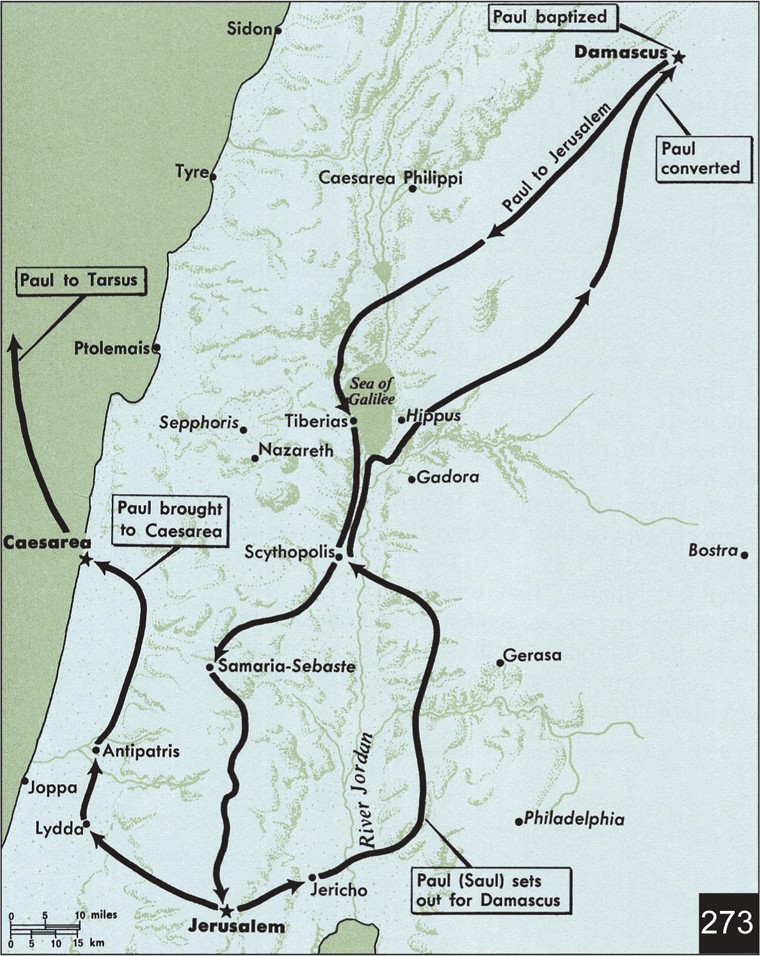
Image from The Carta Bible Atlas
We pick up the story of Sha’ul as he travels to Dammesek to cause even more problems for the young community of Believers. Sha’ul was so incensed against the Messianic Jews (8:3) that he was not satisfied to conduct his inquisitions and persecutions only in Yerushalayim. Letters from the Cohen HaGadol would carry weight in the Diaspora. Under Roman rule, the Sanhedrin did not have temporal power; in internal Jewish matters, it was honored even beyond the borders of Isra’el, for example, in Dammesek (v. 3).
As we will learn in future posts, Sha’ul will become one of the most widely known and read of all the Emissaries. He will make three major missionary journeys establishing Messianic communities throughout what is now modern-day Turkey, Greece, and Italy. Yet, he is feared by all who regard the name of Yeshua as precious. The events that lead to the radical change in this man are truly remarkable. He doesn’t know it yet, but Sha’ul is destined to become a special Emissary for Yeshua, which necessitates his ability to testify personally to the Resurrection of Yeshua. [3]
1 Meanwhile, Sha’ul, still breathing murderous threats against the Lord’s talmidim, went to the Cohen HaGadol 2 and asked him for letters to the synagogues in Dammesek, authorizing him to arrest any people he might find, whether men or women, who belonged to “the Way,” and bring them back to Yerushalayim.
3 He was on the road and nearing Dammesek when suddenly a light from heaven flashed all around him. 4 Falling to the ground, he heard a voice saying to him, “Sha’ul! Sha’ul! Why do you keep persecuting me?” 5 “Sir, who are you?” he asked. “I am Yeshua, and you are persecuting me. 6 But get up, and go into the city, and you will be told what you have to do.” (Yes, more Red-Letter Words. We will see more of these as we follow Sha’ul.)

7 The men traveling with him stood speechless, hearing the voice but seeing no one. 8 They helped Sha’ul get up off the ground, but when he opened his eyes, he could see nothing. So, leading him by the hand, they brought him into Dammesek. 9 For three days, he remained unable to see, and he neither ate nor drank. [4]
While on the road to Dammesek to persecute Believers, Sha’ul encountered the risen Lord and was converted. This marks a momentous occasion in the mission of the early Messianic community. The principal opponent of the Messianic movement became the most fantastic leading role of the movement’s mission, and – amazingly – he would take the Gospel to the “ends of the earth.” [5]
In our next post, we will learn what happens to Sha’ul after his encounter with the Risen Lord.
Click here for the PDF version.
[1] Acts 7:58b-8:1a.
[2] Acts 8:1b-4.
[3] F. LaGard Smith, The Narrated Bible in Chronological Order.
[4] Acts 9:1–9.
[5] Andreas J. Köstenberger, L. Scott Kellum, and Charles L. Quarles, The Cradle, the Cross, and the Crown: An Introduction to the New Testament (Nashville, TN: B&H Academic, 2016), 425. (This is a new resource in my library. In the future, I will refer to it as The Cradle, the Cross, and the Crown.)
 My Heart Is For Israel
Hi Don! I KNOW that I am going to love this study! I so look forward to the insights that you bring! Blessings!
LikeLiked by 1 person
Thanx, Bruce. It will be a long one, I’m sure. Buckle up!!
LikeLike