
Note: To examine the graphics in this series, just click on them for a pop-up version.
Sha’ul’s Immersion
We pick up the story of Sha’ul’s encounter with Yeshua in Acts 9:10.
10 There was a talmid in Dammesek, Hananyah (Ananias) by name, and in a vision, the Lord said to him, “Hananyah!”
Hananyah is described in Acts 22:12 as “an observant follower of the Torah who was highly regarded by the entire Jewish community” of Dammesek. A Torah zealot like Sha’ul (Acts 22:3, Galatians 1:13–14; Acts 21:20, Romans 10:2) would not have found anyone else credible.
He said, “Here I am, Lord.”
“Here I am,” Greek Idou egô (“Behold, I”), corresponding to Hebrew “Hineni”. Hananyah joined a select company when he gave this answer, expressing ready and expectant submission to God. Avraham answered, “Hineni!” when God told him to sacrifice his son Yitzchak (Genesis 22:1), and also when the angel of Adonai told him to stay his hand (Genesis 22:11). Moshe answered, “Hineni!” to God’s call from the burning bush (Exodus 3:4). Shmu’el did the same when God first spoke to him (1 Samuel 3:4–10), likewise Yesha‛yahu when the voice of Adonai asked, “Whom shall I send?” (Isaiah 6:8). Today anyone can say “Hineni!” to God by agreeing that he speaks to us through the Bible, repenting of his sins, accepting God’s forgiveness through Yeshua’s death as atonement, and offering Hhimself to God unconditionally in obedient, holy service. [1]
11 The Lord said to him, “Get up and go to Straight Street, to Y’hudah’s house; and ask for a man from Tarsus named Sha’ul; for he is praying, 12 and in a vision he has seen a man named Hananyah coming in and placing his hands on him to restore his sight.” 13 But Hananyah answered, “Lord, many have told me about this man, how much harm he has done to your people in Yerushalayim; 14 and here he has a warrant from the head cohanim to arrest everyone who calls on your name.”
Hananyah’s fear of Sha’ul was such that he dared to question God’s judgment. Sha’ul’s reputation as an enemy of the Messianic community was well-earned and built as it was on the testimony of many people.
15 But the Lord said to him, “Go, because this man is my chosen instrument to carry my name to the Goyim (Gentiles), even to their kings, and to the sons of Isra’el as well.
God revealed His purpose for Sha’ul to Hananyah first. This ensured Sha’ul would have a support network once he learned of his new purpose in life. Otherwise, imagine Sha’ul coming to Hananyah and delivering the news. Hananyah would have scoffed, assuming he let Sha’ul close enough to speak.
16 For I myself will show him how much he will have to suffer on account of my name.” (We aren’t finished with the Red-Letter Words of Yeshua just because we finished all four Gospels.)
17 So Hananyah left and went into the house. Placing his hands on him, he said, “Brother Sha’ul, the Lord – Yeshua, the one who appeared to you on the road as you were coming here – has sent me so that you may see again and be filled with the Ruach HaKodesh.” 18 In that moment, something like scales fell away from Sha’ul’s eyes; and he could see again. He got up and was immersed (baptized); 19 then he ate some food and regained his strength. [2]
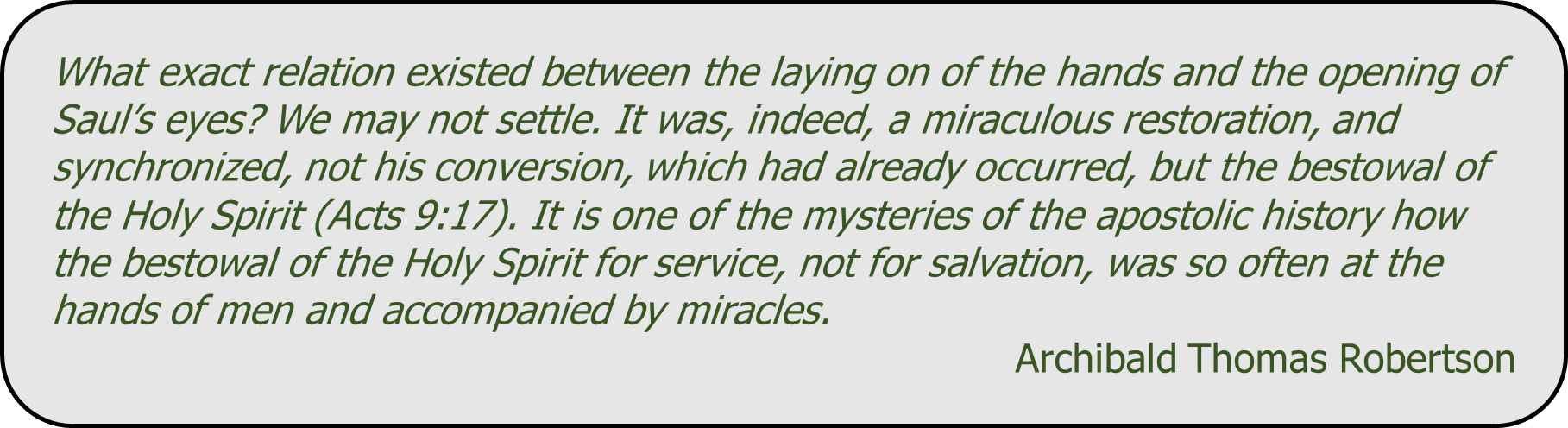
The ordering of events in Sha’ul’s conversion may have been altered from the standard pattern so that baptism rather than the filling of the Ruach HaKodesh was the final event. The process may have been extended over several days rather than coinciding. But the result was the same: Sha’ul became a follower of Yeshua HaMashiach.
Sha’ul spent some days with the talmidim in Dammesek, 20 and immediately, he began proclaiming in the synagogues that Yeshua is the Son of God. 21 All who heard him were amazed. They asked, “Isn’t he the man who in Yerushalayim was trying to destroy the people who call on this name? In fact, isn’t that why he came here, to arrest them and bring them back to the head cohanim?” 22 But Sha’ul was being filled with more and more power and was creating an uproar among the Jews living in Dammesek with his proof that Yeshua is the Messiah. [3]
Sha’ul stayed in Dammesek for some days, likely becoming oriented to fundamental Messianic theology even as he began proclaiming Yeshua in the synagogues. He prioritized the synagogues throughout his ministry, starting there before being forced to take the message elsewhere. Understandably, the initial response to Sha’ul was skeptical amazement, but as he grew more capable, he could confound unbelieving Jews, proving that Yeshua is the Messiah. He was able to explain the Messianic connections between the Tanakh and Yeshua so clearly that the Jews in Dammesek could not refute him.
A Timeline of Sha’ul’s Ministry

In our next post, Sha’ul heads back to Yerushalayim.
[1] David H. Stern, Jewish New Testament Commentary: A Companion Volume to the Jewish New Testament.
[2] Acts 9:10–19a.
[3] Acts 9:19b–22.
 My Heart Is For Israel