
Sha’ul and Bar-Nabba’s First Missionary Journey ~ Part 2
Note: To examine the graphics in this series, just click on them for a pop-up version.
We pick up the ongoing story of Sha’ul in Acts 13:13.
Sha’ul’s Sermon in Pisidian Antioch ~ Part 1
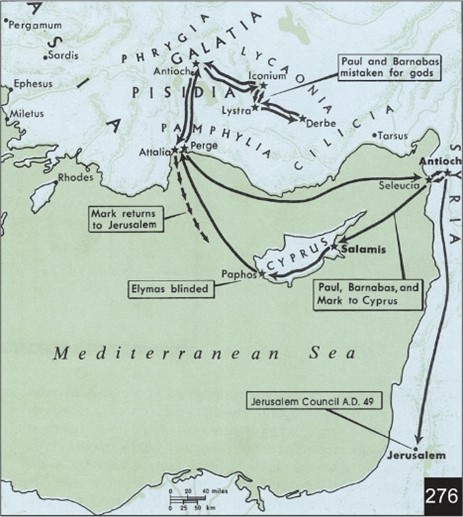
13 Having set sail from Paphos, Sha’ul and his companions arrived at Perga in Pamphylia. There Yochanan (Mark) left them and returned to Yerushalayim, 14 but the others went on from Perga to Pisidian Antioch, and on Shabbat, they went into the synagogue and sat down. 15 After the reading from the Torah and from the Prophets, the synagogue leaders sent them a message, “Brothers, if any of you has a word of exhortation for the people, speak!”
Without his name even being mentioned, this verse pays the greatest of all tributes to Bar-Nabba. So far, the order has always been Bar-Nabba and Sha’ul (Acts 13:2). It was Bar-Nabba who had set out as the leader of this expedition. But now it is Sha’ul and Bar-Nabba. Sha’ul has assumed the expedition’s leadership, and the lovely thing about Bar-Nabba is that there is no word of complaint from him. He was prepared to take second place so long as God’s work was done.
One of the fantastic things about Acts is the heroism that is passed over in a sentence. Pisidian Antioch stood on a plateau 3,600 feet above sea level. To get to it, Sha’ul and Bar-Nabba would have to cross the Taurus range of mountains by one of the most challenging roads in Asia Minor, a road which was also notorious for robbers and brigands.
The main interest of verse 13 is that it is an element in the biography of Yochanan (Mark), a deserter who redeemed himself. Mark was very young. His mother’s house seems to have been the center of the Messianic community in Yerushalayim (Acts 12:12), and he must always have been close to the center of the faith. Sha’ul and Bar-Nabba took him with them as their helper, for he was relative to Bar-Nabba, but he turned and went home. We will never know why. [1]
After the reading from the Torah and from the Prophets, then as now, on Shabbat, there was added to the liturgy a reading from the Torah (the Pentateuch) and a haftarah (“conclusion”), which consisted of a reading from the Nevi’im (Prophets) or Ketuvim (Writings). Following this would be a drashah (literally, “investigation,” i.e., teaching or sermon), depending on who was available to teach or preach. Hospitality often dictated offering this honor to a visitor if he was competent (see Luke 14:16-17 where Yeshua was given this honor).
Sha’ul’s sermon in Pisidian Antioch’s synagogue illustrates how he presented the Gospel to Jews. As with Stephen’s speech in Acts 7:2–53, the appeal is through the history of God’s dealings with the people of Isra’el. Eventually, Yeshua is presented as the “Son of David,” a term everyone understood to mean the Messiah.
16 So Sha’ul stood, motioned with his hand, and said: “Men of Isra’el and God-fearers, listen!
God-fearers. Besides Sha’ul’s conviction that it was right to present the Gospel first to Jews (v. 5), he also knew that it was in the synagogues where he would find the Gentiles most likely to be responsive since “proselytes of the gate” were already interested in the one true God. One aspect of communicating the Gospel is determining which people will likely respond favorably. Sha’ul wasted little time trying to convince those who closed themselves off but invested much time in reaching people open to it. In this regard, the Jewish community is no different from Gentile communities. There is a full spectrum of receptiveness from persons relentlessly opposed to those whose hearts are waiting and aching for God’s Good News.
17 The God of this people, Isra’el, chose our fathers. He made the people great during the time when they were living as aliens in Egypt, and with a stretched-out arm, He led them out of that land. 18 For some forty years, He took care of them in the desert, 19 and after He had destroyed seven nations in the land of Kena’an, He gave their land to His people as an inheritance. 20 All this took about 450 years. (400 years in Egypt, 40 in the Wilderness, and 10 until Joshua divided the Land.) After that, He gave them judges, down to the prophet Sh’mu’el. 21 Then they asked for a king, and God gave them Sha’ul Ben-Kish, a man from the tribe of Binyamin. After forty years, 22 God removed him and raised up David as king for them, making His approval known with these words, ‘I found David Ben-Yishai to be a man after my own heart; he will do everything I want.’ [2]
In our next post, Sha’ul and Bar-Nabba continue their First Missionary Journey.
Click here for the PDF version.
[1] William Barclay, The Acts of the Apostles.
[2] Acts 13:13–22.
 My Heart Is For Israel