First Letter to the Thessalonians ~ Part 8
Note: To examine the graphics in this series, click on them for a pop-up version.
We pause our ongoing story of Sha’ul’s Second Missionary Journey as we dig into his first letter to the Thessalonians while in Corinth.
Various Exhortations
12 We ask you, brothers, to respect those who are working hard among you, those who are guiding you in the Lord and confronting you in order to help you change.
Sha’ul seems to be urging the Thessalonians to respect those who labored and supported the church. These people likely held leadership positions within the church (compare 1 Corinthians 16:15–18).
13 Treat them with the highest regard and love because of the work they are doing. Live at peace among yourselves; 14 but we urge you, brothers, to confront those who are lazy, your aim being to help them change, to encourage the timid, to assist the weak, and to be patient with everyone.
To confront those who are lazy refers to Believers in Thessalonica who refused to work and support themselves. Such people took advantage of wealthy fellow Believers because of their disdain for work.
15 See that no one repays evil for evil; on the contrary, always try to do good to each other, indeed, to everyone.
The Thessalonians may have been tempted to retaliate against those who persecuted them. Sha’ul advises them against this (Mattityahu 5:39–40; Romans 12:19). Believers must extend to others (i.e., Believers and un-Believers) the same goodness the Lord has shown them.
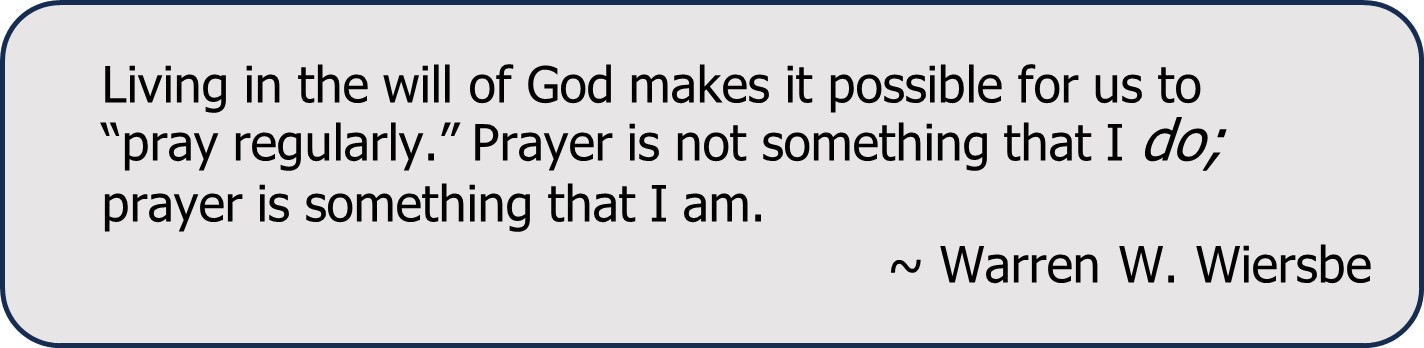
16 Always be joyful. 17 Pray regularly.
The KJV has “Pray without ceasing,” but this suggests praying mindlessly, like reciting a Hindu mantra, which is not what Sha’ul means (compare Mattityahu 6:7–8). He intends that Believers should make prayer a regular habit, as it is for himself (1 Thessalonians 3:10) and for Jews generally.
18 In everything, give thanks, for this is what God wants from you who are united with the Messiah Yeshua. 19 Don’t quench the Spirit, 20 don’t despise inspired messages.
In light of the controversy over the charismatic movement (see 1 Corinthians 12:8–10), this passage, like 1 Corinthians 12–14, counsels a middle course. Prophetic messages are not to be rejected out of hand but to be tested against Scripture and by the other prophets (1 Corinthians 14:32–33).
The Greek word for “Spirit” (pneuma) refers to the Holy Spirit, the third person of the Trinity. The Brit Hadashah uses the imagery of fire to describe the Spirit’s presence and activity (Mattityahu 3:11; Acts 2:3; 2 Timothy 1:6). Sha’ul uses the image of quenching to describe the idea of resisting the Spirit’s work in and among Believers. In this context, quenching the Spirit likely refers to prohibiting prophetic activity within the Thessalonian church.
21 But do test everything – hold onto what is good, 22 but keep away from every form of evil.
Benediction
23 May the God of Shalom make you completely holy – may your entire spirit, soul, and body be kept blameless for the coming of our Lord Yeshua the Messiah. 24 The one calling you is faithful, and he will do it.
The essence of peace is the absence of war and holiness, which means living a life centered on and guided by God. Whether a human being consists of three parts body, soul, and spirit – as this verse and Messianic Jews 4:12 suggest, or two (“body” and “soul” (Mattityahu 10:28), physical and spiritual (1 Corinthians 5:3), etc.), is less important than that the whole person, the entire “living soul” or “living being” (Genesis 2:7), should become holy. This will happen to Believers because God is faithful and will do it.
25 Brothers, keep praying for us.
Sha’ul’s request for prayer is striking. If Sha’ul, the apostle, needed prayer, how much more do we each need each other’s prayer?
26 Greet all the brothers with a holy kiss.
Greeting one another with a holy kiss, probably on the cheek, was a standard first-century greeting that expressed love like a modern handshake (Romans 16:16) or a one-arm hug (we practice that in our church regularly). This ancient custom is still widely practiced in the Middle East.
27 I charge you in the Lord to have this letter read to all the brothers. 28 The grace of our Lord Yeshua the Messiah be with you.1
Sha’ul usually ended his letters in his own hand (2 Th 3:17). I charge you; it was intense, almost like asking them to take an oath. Sha’ul insisted that all the brothers needed to hear the letter’s contents, even if it entailed reading it several times in different places.
In our next post, we begin to explore Shaul’s Second Letter to the Thessalonians beginning in 2 Thess. 1:1.
Click here for the PDF version.
1 1 Thessalonians 5:12-23.
 My Heart Is For Israel