
Second Letter to the Thessalonians ~ Part 4
Note: To examine the graphics in this series, click on them for a pop-up version.
We paused our ongoing story of Sha’ul’s Second Missionary Journey as we began to dig into his second letter to the Thessalonians while in Corinth. Now, we conclude our exploration of his second letter.
Warning Against Idleness
6 Now, in the name of the Lord Yeshua the Messiah, we command you, brothers, to stay away from any brother who is leading a life of idleness, a life not in keeping with the tradition you received from us.
In the name of the Lord Yeshua the Messiah, we command you. Sha’ul dealt mildly with the problem of laziness at 1 Thess. 4:11–12. Here, he takes a firmer hand (vv. 10–14); he has strong opinions on the subject (1 Timothy 5:8). In this regard, he makes himself an example to imitate (vv. 7–9; compare 1 Corinthians 9:4–19, 10:33–11:1; 2 Corinthians 11:7–15).
7 For you yourselves know how you must imitate us, that we were not idle when we were among you. 8 We did not accept anyone’s food without paying; on the contrary, we labored and toiled, day and night, working so as not to be a burden to any of you.
Sha’ul had the right to receive financial support while working in evangelism and teaching, but he set an example for the Thessalonians by working to provide for his own needs so he did not burden them.
9 It was not that we hadn’t the right to be supported, but so that we could make ourselves an example to imitate.
Sha’ul worked when he was with them to show them the importance of work. But more than this, “his actions might illustrate generosity, humility, self-sacrifice, a willingness to work hard for the kingdom, acceptance of personal responsibility, and/or numerous other virtues.” [1]
10 For even when we were with you, we gave you this command: if someone won’t work, he shouldn’t eat!
Whatever the reason for this behavior, Sha’ul commanded, If anyone isn’t willing to work, he should not eat (see Gen 3:18–19). Messianic charity is directed at actual need, not artificial need created by irresponsibility.
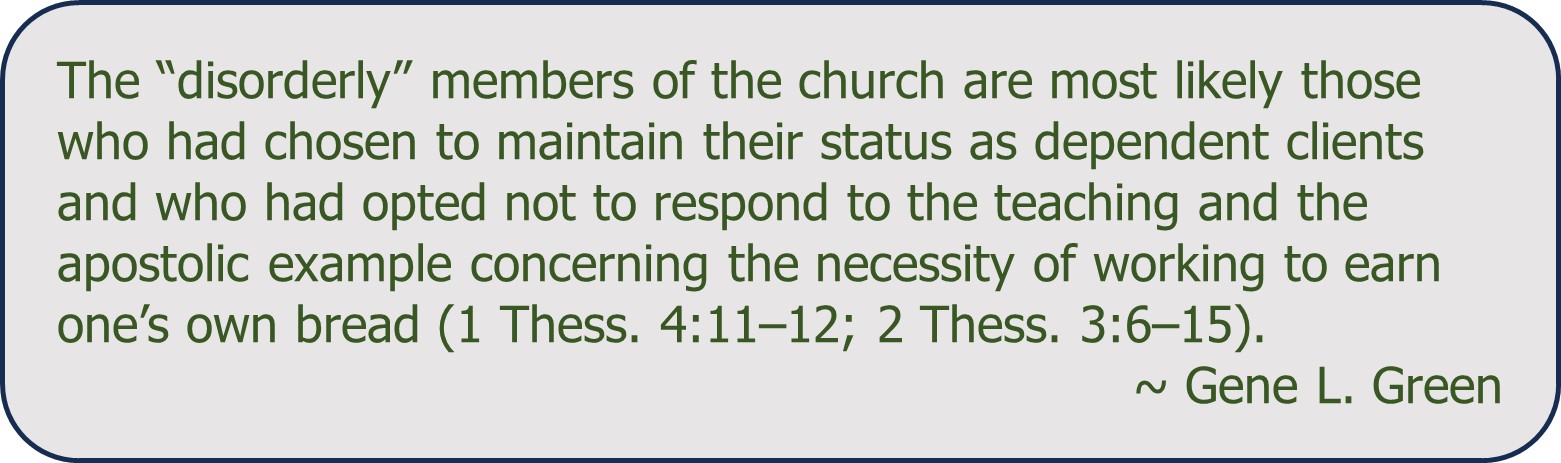
11 We hear that some of you are leading a life of idleness—not busy working, just busybodies! 12 We command such people—and in union with the Lord Yeshua the Messiah, we urge them – to settle down, get to work, and earn their own living.
To compound the problem, not only did some Thessalonians not work, but they were interfering with the work of others, perhaps encouraging them not to work to focus on the Day of the Lord.
13 And you brothers who are doing what is good, don’t slack off! 14 Furthermore, if anyone does not obey what we are saying in this letter, take note of him and have nothing to do with him so that he will be ashamed. 15 But don’t consider him an enemy; on the contrary, confront him as a brother and try to help him change.
The practice of “shunning,” found, for example, among the Amish in Pennsylvania, is based on passages such as this in verses 14-15, 1 Corinthians 5:4–13, and 2 Corinthians 2:5–11. Popular journalistic accounts present it as cruel. Without judging how it is done, we can see from this and the other passages cited that its purpose should not be primarily punishment but ministry. On the phrase, confront him … and try to help him change,” see 1 Corinthians 4:14.
Benediction
16 Now may the Lord of Shalom himself give you shalom always in all ways. The Lord be with all of you.
Sha’ul referred to the Lord as the Lord of peace and prayed for God’s granting of peace to them in every way. This was particularly important for a church under persecution.
17 The greeting in my own handwriting: From Sha’ul. This is the mark of genuineness in every letter; this is what my handwriting looks like. 18 The grace of our Lord Yeshua the Messiah be with you all. [2]
The final greeting was written in Sha’ul’s hand, which indicates a common ancient practice. The rest of the letter was written with the help of a skilled scribe, called an amanuensis, who wrote as Sha’ul directed him.
In our next post, we will return to Acts 18:12 to continue the historical record of the account of Shaul’s persecution in Corinth.
Click here for the PDF version.
[1] Holman Illustrated Bible Commentary.
[2] 2 Thess. 3:6–17.
 My Heart Is For Israel