
1 Corinthians ~ Part 1
Note: To examine the graphics in this series, click on them for a pop-up version.
As I mentioned in my last post, we leave for several posts in the Book of Acts and begin to explore Sha’ul’s Letters to the Corinthians.
Introduction
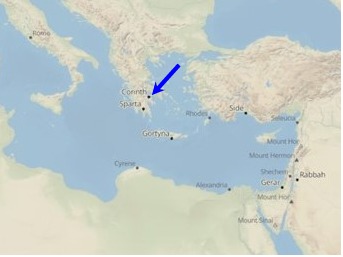
1 and 2 Corinthians represent at least two of the four or more letters that Sha’ul wrote to his church in Corinth, together with the churches in the region of Achaia which surrounded this crucial Roman city (1 Corinthians 1:2; 2 Corinthians 1:1; Romans 16:1). As its founder (1 Corinthians 4:14–15; 2 Corinthians 10:13–14), Sha’ul knew well the church’s history, character and problems. 1 Corinthians provides the most detailed example within Sha’ul’s corpus of how Sha’ul applied his theological convictions, especially his Christology and eschatology, [1] to the church’s practical issues. In contrast, due to the circumstances which later developed in Corinth with the arrival of Sha’ul’s opponents, 2 Corinthians contains Sha’ul’s most sustained apologetic for his apostolic authority of any of Sha’ul’s letters. In addition, both letters deal with the collection of the saints in Yerushalayim, which was so crucial to Sha’ul (1 Cor 16:1–9; 2 Cor 8–9).[2]
Sha’ul had sent a letter to the church in Corinth through the hands of Timothy, who had recently passed through Corinth on his way to Macedonia. In a second letter, written perhaps in 55-56 CE, Sha’ul mentions the previous letter and indicates that he has received a return letter from the Corinthians, which has been brought to Ephesus by a group including Stephanas, Fortunatus, and Achaicus. Although the content of Sha’ul’s first letter is unknown, the letter that Sha’ul received from the Corinthians posed specific questions regarding marriage and singleness; food sacrificed to idols, spiritual gifts, and specific questions the Corinthians were making. Sha’ul answers these questions in his second letter (traditionally referred to as 1 Corinthians) and expresses concern about various divisions among the Corinthians, which have been reported to Sha’ul by members of Cloe’s family. Additionally, Sha’ul addresses some of the particular problems these Corinthians face in the pagan City of Corinth, including matters about sexual morality and modesty and the issue of fellowship with pagans. [3]
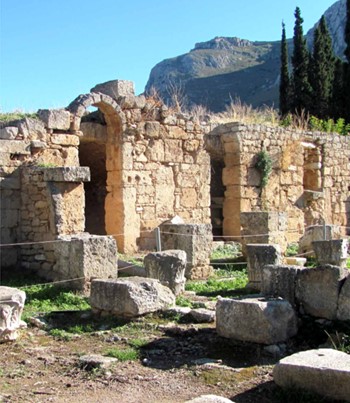
Shops also sat on the city’s west end, just below the Temple of Hera, the wife of Zeus.
Salutation
11 From: Sha’ul, called by God’s will to be an emissary of the Messiah Yeshua; and from brother Sosthenes,
Brother Sosthenes was perhaps a successor to Crispus (v. 14) as president of the synagogue in Corinth (Acts 18:8, 17). Formerly a vehement opponent of Sha’ul and his Gospel, he grew so close to him as to be his partner in writing this letter so that those in Corinth who deprecated Sha’ul’s authority (chapters 4 and 9, 2 Corinthians 10–12) might at least respect a prominent fellow Corinthian. Sha’ul himself is an even better example of a virulent adversary who became a strong supporter of Yeshua.
2 To: God’s Messianic community in Corinth, consisting of those who have been set apart by Yeshua the Messiah and called to be God’s holy people—along with everyone everywhere who calls on the name of our Lord Yeshua the Messiah, their Lord as well as ours:
Everyone everywhere. This refutes the view that Sha’ul’s letters, written to specific congregations with specific problems, are not normative for us. However, how they are normative depends on the correct interpretation.
3 Grace to you and shalom from God our Father and the Lord Yeshua the Messiah. [4]
In our next post, we will continue to explore Sha’ul’s Letters to the Corinthians beginning in 1 Corinthians 1:4.
Click here for the PDF version.
[1] The part of theology concerned with death, judgment, and the final destiny of the soul and of humankind.
[2] Scott J. Hafemann, “Corinthians, Letters to The,” Dictionary of Paul and His Letters, 164.
[3] F. LaGard Smith, The Narrated Bible in Chronological Order. 1531-1532.
[4] 1 Corinthians 1:1-3.
 My Heart Is For Israel