
1 Corinthians ~ Part 24
Note: To examine the graphics in this series, click on them for a pop-up version.
As I emphasized in my previous post, we are delving into the profound significance of Sha’ul’s Letters to the Corinthians, a crucial cornerstone of our faith.
Regarding Spiritual Gifts ~ Part 4
Prophecy Vs. Tongues
We left off in the last post with verse 14:1a. I thought starting this post by repeating it might be helpful.
1a Pursue love!
1b However, keep on eagerly seeking the things of the Spirit; and especially seek to be able to prophesy. 2 For someone speaking in a tongue is not speaking to people but to God, because no one can understand, since he is uttering mysteries in the power of the Spirit. 3 But someone prophesying is speaking to people, edifying, encouraging, and comforting them. 4 A person speaking in a tongue does edify himself, but a person prophesying edifies the congregation. 5 I wish you would all speak in tongues, but even more I wish you would all prophesy. The person who prophesies is greater than the person who speaks in tongues unless someone gives an interpretation so that the congregation can be edified.
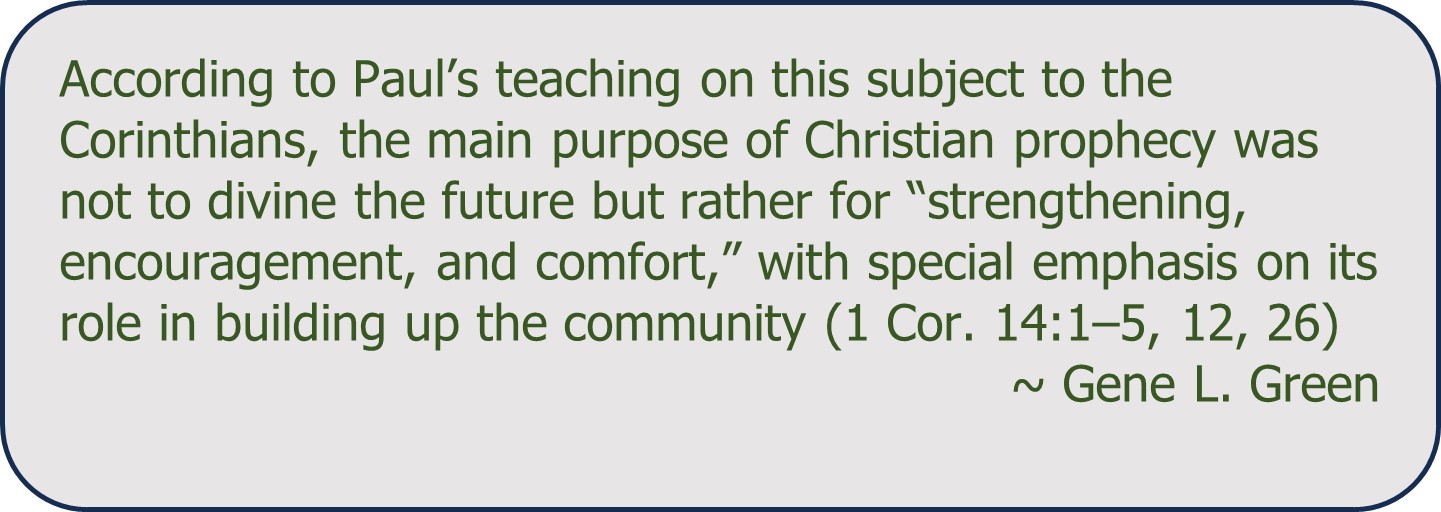
Given the framework of love (chapter 13), it is desirable to keep on eagerly seeking the things of the Spirit (1 Corinthians 12:1), especially … to be able to prophesy, for the gift of prophecy is greater than the gift of tongues; however, the latter, plus interpretation, equals prophecy (v. 5). Prophecy is more remarkable because it edifies the congregation, whereas speaking in tongues edifies only oneself—although this is good, not bad (“ … if I pray in a tongue, my spirit does pray,” v. 14), so that Sha’ul can say, I wish you would all speak in tongues; and in this regard, as is so often the case, he sets the standard (v. 18).
Tongues Need Interpretation
6 Brothers, suppose I come to you now speaking in tongues. How can I be of benefit to you unless I bring you some revelation or knowledge or prophecy or teaching? 7 Even with lifeless musical instruments, such as a flute or a harp, how will anyone recognize the melody if one note can’t be distinguished from another? 8 And if the bugle gives an unclear sound, who will get ready for battle? 9 It’s the same with you: how will anyone know what you are saying unless you use your tongue to produce intelligible speech? You will be talking to the air! 10 There are undoubtedly all kinds of sounds in the world, and none is altogether meaningless; 11 but if I don’t know what a person’s sounds mean, I will be a foreigner to the speaker, and the speaker will be a foreigner to me. 12 Likewise with you: since you eagerly seek the things of the Spirit, seek especially what will help in edifying the congregation.
Sha’ul’s point is that speaking other languages is pointless unless content is communicated. Just as a foreigner is estranged by those speaking a language he does not know, so too do members of the body of Believers become estranged from one another if unintelligible, untranslated languages are spoken in the church. Rather than being selfishly ambitious with spiritual gifts, believers must strive to build up the body of Believers.
Tongues Cannot Edify
This section includes an apostolic ruling in which Sha’ul declares the necessity of intelligible language over untranslated languages to enlighten the Kehilah.
Therefore, someone who speaks in a tongue should pray for the power to interpret. 14 For if I pray in a tongue, my spirit does pray, but my mind is unproductive. 15 So, what about it? I will pray with my spirit, but I will also pray with my mind; I will sing with my spirit, but I will also sing with my mind. 16 Otherwise, if you are giving thanks with your spirit, how will someone who has not yet received much instruction be able to say, “Amen,” when you have finished giving thanks, since he doesn’t know what you are saying? 17 For undoubtedly you are giving thanks very nicely, but the other person is not being edified. 18 I thank God that I speak in tongues more than all of you, 19 but in a congregation meeting, I would rather say five words with my mind in order to instruct others than ten thousand words in a tongue! [1]
The edification measures the legitimacy of a person’s speech amid the congregation it brings the body of Believers. Speeches, prayers of blessing, and expressions of thanksgiving cannot edify the body if they are unintelligible (i.e. if the congregants remain uninformed). Sha’ul’s statement, I will pray with my spirit, but I will also pray with my mind, means he will pray in a way that is both intelligible to bystanders and drawn from his spirit. I thank (eucharisto in Greek) can express either thanksgiving to God (“I give thanks”) or prayer (“I pray with thanksgiving”). More than all of you indicates that Sha’ul was not merely speaking from theory in his instructions about other languages and their proper practice in the Kehilah.
Personally, I do not have the gift of tongues as described by Sha’ul, but I do have an unknown language that I use in prayer from time to time.
In our next post, we will eagerly explore Sha’ul’s Letters to the Corinthians, starting with 1 Corinthians 14:20 and delving deeper into the topic of Regarding Spiritual Gifts. Stay tuned for more insights and revelations.
Click here for the PDF version.
[1] 1 Corintians 14:1–19.
 My Heart Is For Israel
Hi Don, Your statement “Personally, I do not have the gift of tongues as described by Sha’ul, but I do have an unknown language that I use in prayer from time to time.” Me too. Blessings, brother!
LikeLiked by 1 person