
Romans ~ Part 2
Note: To examine the graphics in this series, click on them for a pop-up version.
As I have emphasized in my previous post, we begin delving into the profound significance of Sha’ul’s Letter to the Romans, a crucial cornerstone of our faith. This significance is not to be taken lightly but deeply understood and appreciated. Your active engagement in grasping the depth of its meaning and impact on our spiritual journey is not just crucial. Still, it also shows your responsibility to understand the importance of this text in our faith.
Feeling overwhelmed by societal pressures that challenge your Messianic beliefs? Remember the call in Romans 1 to be set apart for God’s purposes. To overcome this, seek out like-minded colleagues at work or in your church for support and fellowship. Start a workplace Bible study or prayer group to encourage one another in faith. Finding strength in knowing God’s Word offers guidance and wisdom in navigating challenging cultural norms. I did this throughout my secular career in local government.
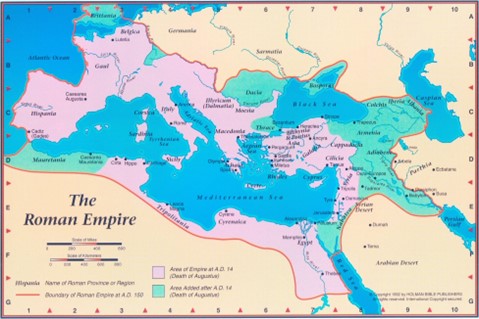
I thought it might be helpful to include this map of the Roman Empire when Sha’ul wrote to the Believers in Rome. Remember that he had not been there yet.
Salutation
11 From Sha’ul, a slave of the Messiah Yeshua, an emissary because I was called and set apart for the Good News of God. 2 God promised this Good News in advance through His prophets in the Tanakh.
God promised this Good News in advance. In his letter to the Romans, Sha’ul always shows how the great truths he expounds are derived from God’s prophets in the Tanakh (what Christians call the Old Testament). As Edith Schaeffer put it in a book titled, “Christianity is Jewish.”
3 It concerns His Son—He is descended from David physically; 4 he was powerfully demonstrated to be Son of God spiritually, set apart by his having been resurrected from the dead; he is Yeshua the Messiah, our Lord.
His Son, i.e., the Son of God (Mattityahu 4:3). The Greek text of v. 4 is complex and can be rendered differently. Still, its form suggests that Sha’ul is quoting a hymn, a fact reflected by the three parallel clauses describing Yeshua:
- He is descended from David, physically (literally, “of the seed of David according to the flesh”), through his mother Miryam (Lk 3:23–38). Her husband Yosef was also was caused to give birth by Godescended from King David (Mattityahu 1:1–16) but was not Yeshua’s physical father, for Miryama’s Holy Spirit (Mattityahu 1:18–2:12; Luke 1:26–56, 2:1–38). While God is in one sense father to everyone and in a more intimate sense to the people of Isra’el (Exodus 4:22, Mattityahu 2:15). He is father in this unique sense only to Yeshua.
- He is Son of God spiritually. Yeshua is, therefore, a man set apart (or: “designated,” “determined”), different from other people in that He alone was qualified to bring salvation to humanity. This is powerfully demonstrated less by His manner of birth than by His having been resurrected from the dead since that happened after a widely known ministry and was a public fact witnessed on several occasions. Moreover, His resurrection also powerfully demonstrates that Believers are assured of their resurrection (8:28–39, 1 Corinthians 15:12–57); this, too, is a consequence of His being the Son of God, spiritually.
- He is Yeshua the Messiah, our Lord. His being the Son of David makes Him the His being Son of God implies that He shares God’s very nature (Mattityahu 4:3) and is worthy to be called our Lord.
5 Through Him we received grace and were given the work of being an emissary on His behalf, promoting trust-grounded obedience among all the Gentiles, 6 including you, who have been called by Yeshua the Messiah.
Sha’ul’s commission from Yeshua is to promote trust-grounded obedience. But this expression is ambiguous. Sha’ul does not mean “the obedience which is faith,” but he is not saying that obedience consists of having faith in Yeshua. Instead, he is speaking of the good works that flow from obeying God—the necessary deeds to truly trust God, His Word, and His Messiah. This must be said because Sha’ul is often portrayed as promoting faith and opposing works. The wrongness of such an oversimplification is discussed in Romans 3:27–28, Ephesians 2:8–10, and Ya’akov (James) 2:14–26. Sha’ul’s self-definition of his ministry at this early point in the letter and again at the end of it (16:26) must be kept in mind when reading Romans. He passionately opposes legalism (works stemming from prideful self-sufficiency that ignores trust and regards performing good deeds as doing God a favor) and antinomianism (undisciplined living that ignores the obedience that leads to right action).
Among all the Gentiles, including you. Sha’ul is writing to a mixed congregation of Gentiles and Jews. While his teaching in Romans is actual (and the truth is the same for both Gentiles and Jews), much of what he writes is directly applicable only to Gentiles. Understanding the Letter to the Romans properly depends on determining which portions apply to everyone and which apply directly only to non-Jews. [1]
7 To: All those in Rome whom God loves, who have been called, who have been set apart for him:
Grace to you and shalom from God our Father and the Lord Yeshua the Messiah. [2]
Grace to you and shalom (more than merely “peace”; see Mattityahu 10:12) from God our Father and the Lord Yeshua the Messiah. This is Sha’ul’s usual greeting, found in one form or another at the beginning of all his letters.
In our next post, we continue to examine Sha’ul’s Letter to the Romans.
Click here for the PDF version.
[1] David H. Stern, Jewish New Testament Commentary, Romans 1:5-6.
[2] Romans 1:1-7.
 My Heart Is For Israel