
Ephesians – Part 1
Note: To examine the graphics in this series, click on them for a pop-up version.
Ephesians instructs Believers to be imitators of God. In practical terms, make a list of attributes related to God’s character—like love, patience, and kindness—and consciously apply one attribute daily in your public life. For example, dedicate a day to practicing patience with anyone who may test you, such as a difficult coworker or a busy cashier. Your example can inspire others to reflect on Yeshua’s love.
Introduction
Ephesians (probably written between 60 & 62 CE) resembles a typical Rabbinic discourse. In the first three chapters, Sha’ul, the respected rabbi, gives Torah instructions about who God is and how to relate to Him as individuals and as the collective body of the Messiah. The rest of the letter lays out the halakhah (click on the Glossary at the top of the page), which is a practical way to live according to the Torah.
The first half of this letter has few, if any, direct quotes from the Torah, but there are many concepts from it. In the second half, which deals more with how the community functions with God and one another, Sha’ul includes several quotations, basing his instructions squarely upon the Torah. [1]
Salutation
11 From: Sha’ul, by God’s will, an emissary of the Messiah Yeshua
To: God’s people living in Ephesus, that is, those who are trusting in the Messiah Yeshua:
2 Grace to you and shalom from God our Father and the Lord Yeshua the Messiah.
Revelation of God’s Mystery
The following verses in this post form a single sentence in the Greek text and are so rendered in KJV. Their form is that of a Jewish b’rakhah (benediction). The first words signal this, Praised be Adonai, Father of our Lord Yeshua the Messiah, which echoes the initial phrases of the ˓Amidah, the central prayer of the synagogue liturgy, recited three times daily—Barukh attah, Adonai, Eloheynu v˒’Elohey-avoteynu, Elohey-Avraham, Elohey-Yitzchak, v˒Elohey-Ya’˓akov … (“Praised be you, Adonai, our God and God of our fathers, God of Abraham, God of Isaac and God of Jacob … ”).
Other expressions are also reminiscent of the synagogue prayers. Two examples: he chose us in love (v. 4), which resembles the close of the Ahavah benediction immediately preceding the recital of the ˓Amidah, “Praised be you, Adonai, who has chosen your people Israel in love”; and, In all his wisdom and insight he has made known to us (vv. 8–9), which recalls the fourth blessing of the ˓Amidah: “You favor humanity with knowledge and teach people understanding. Favor us with knowledge, understanding, and insight from yourself. Praised be you, Adonai, gracious Giver of knowledge.”
Moreover, the refrain in v. 6, and would be worthy of praise commensurate with the glory of the grace he gave us (literally, “unto praise of glory of the grace of him, which he graced us”), and its condensations in vv. 12 and 14, dividing the passage into three periods, function like the words, Barukh attah, Adonai, which close each of the nineteen ˓Amidah of the ˓Amidah.
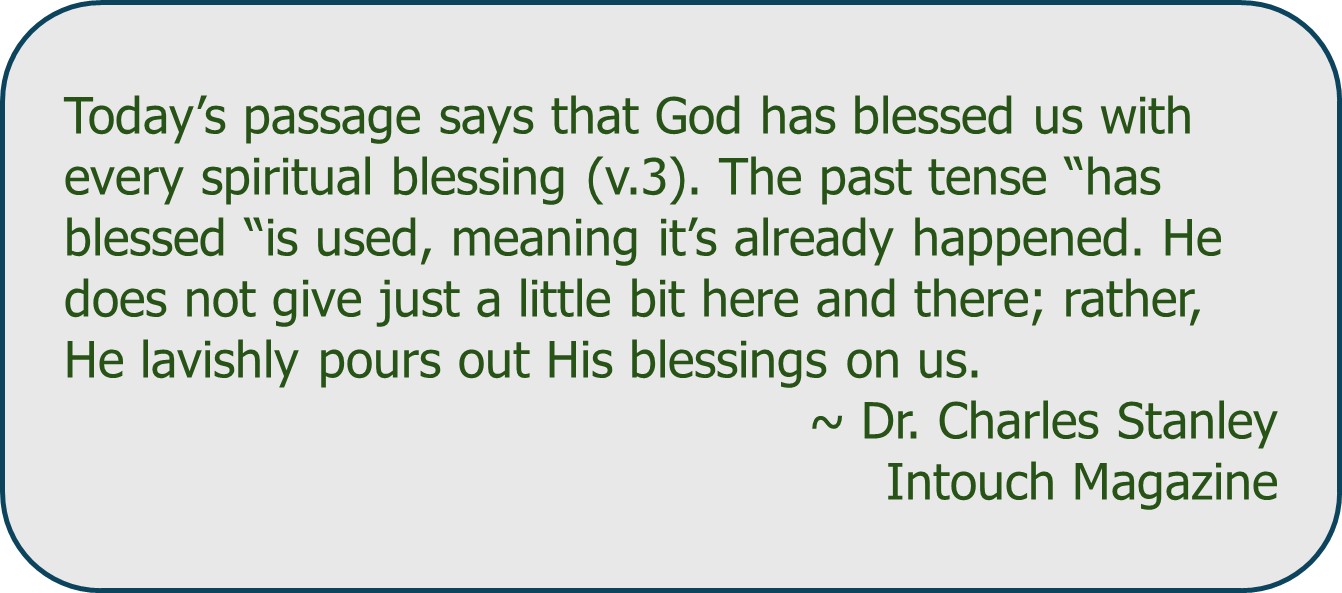
3 Praised be Adonai, Father of our Lord Yeshua the Messiah, who in the Messiah has blessed us with every spiritual blessing in heaven.
4 In the Messiah, he chose us in love before the creation of the universe to be holy and without defect in his presence. 5 He determined in advance that through Yeshua the Messiah we would be his sons—in keeping with his pleasure and purpose—6 so that we would bring him praise commensurate with the glory of the grace he gave us through the Beloved One.

7 In union with him, through the shedding of his blood, we are set free—our sins are forgiven; this accords with the wealth of the grace 8 he has lavished on us. In all his wisdom and insight 9 he has made known to us his secret plan, which by his own will he designed beforehand in connection with the Messiah 10 and will put into effect when the time is ripe—his plan to place everything in heaven and on earth under the Messiah’s headship.
Hope In Yeshua Is Sealed
13 Furthermore, you who heard the message of the truth, the Good News offering you deliverance, and put your trust in the Messiah were sealed by him with the promised Ruach HaKodesh, 14 who guarantees our inheritance until we come into possession of it and thus bring him praise commensurate with his glory. [2]
Sealed with the promised Ruach HaKodesh: The Ruach HaKodesh was promised by the prophets and by Yeshua (Joel 2:28–29; Jn 14:15–26; 16:5–16). The Ruach HaKodesh is described as both a seal showing ownership and as a pledge pointing to future redemption. Though Believers have not yet experienced redemption in full, God will bring about final redemption (life in His immediate presence) for all who have received the Ruach HaKodesh (Ephesians 1:14).
Click here for the PDF version.
[1] The Complete Jewish Study Bible, published by Hendrickson Bible Publishing.
[2] Ephesians 1:1-14.
 My Heart Is For Israel