
1 Corinthians ~ Part 20
Note: To examine the graphics in this series, click on them for a pop-up version.
As I emphasized in my previous post, we are delving into the profound significance of Sha’ul’s Letters to the Corinthians, a crucial cornerstone of our faith.
Regarding Body Unity and Fellowship
Problem With Fellowship
Since Sha’ul’s letters were written before any of the Gospels, this is the oldest record of the Last Supper in the Brit Hadashah. The subject of the Lord’s Supper was raised at 10:16–21 and is now the second matter concerning public worship, to which Sha’ul addresses himself in this section of the letter. Compare the reports of the Last Supper in the Gospels: Mattityahu 26:20–30, Mark 14:17–26, Luke 22:14–20, Yochanan 13:1–14:31.
17 But in giving you this next instruction, I do not praise you because when you meet together, it does more harm than good! 18 For, in the first place, I hear that when you gather together as a congregation, you divide up into cliques, and to a degree, I believe it
Sha’ul chided the Corinthian Believers for their inappropriate, divisive behavior when they met together.
19 (granted that there must be some divisions among you in order to show who are the ones in the right). 20 Thus, when you gather together, it is not to eat a meal of the Lord; 21 because as you eat your meal, each one goes ahead on his own; so that one stays hungry while another is already drunk! 22 Don’t you have homes to eat and drink in? Or are you trying to show your contempt for God’s Messianic community and embarrass those who are poor? What am I supposed to say to you? Am I supposed to praise you? Well, for this, I don’t praise you!
Sha’ul explains briefly that divisions do not challenge God’s sovereignty over his flock because God has ordained that divisions will occur in order to sift the flock and allow true Believers to be made known (compare Luke 8:17). When the community comes together for the Last Supper, their divisions become apparent in two ways—they do not partake together, and some are turning the meal into a party, while others do not get to partake at all. Sha’ul’s questions are rhetorical. His first question is saying that they should eat their regular meals at home (see also 1 Corinthians 11:34). His second question is to help them see how much harm they were causing—some of the poorer members of the congregation are seeing the others gorging, and it is humiliating to them because they are poor and don’t have enough food.
Supper As Reminder of Unity
23 For what I received from the Lord is just what I passed on to you—that the Lord Yeshua, on the night he was betrayed, took bread; 24 and after he had made the b’rakhah he broke it and said, “This is my body, which is for you. Do this as a memorial to me”; 25 likewise also the cup after the meal, saying, “This cup is the New Covenant effected by my blood; do this, as often as you drink it, as a memorial to me.” 26 For as often as you eat this bread and drink the cup, you proclaim the death of the Lord, until he comes.
At Pesach (Passover), Jews all over the world retell the story of the plagues and the Exodus and thus proclaim the central fact on which their peoplehood is founded (see 1 Corinthians 5:6–8). Likewise, members of the Messianic Community are to proclaim the death of the Lord as their exodus from sin and as the basis for their existence. Both proclamations look not only back toward a past redemption but also forward to a future one; hence, the proclamation is until He comes the second time.
27 Therefore, whoever eats the Lord’s bread or drinks the Lord’s cup in an unworthy manner will be guilty of desecrating the body and blood of the Lord! 28 So let a person examine himself first, and then he may eat of the bread and drink from the cup; 29 for a person who eats and drinks without recognizing the body eats and drinks judgment upon himself. 30 This is why many among you are weak and sick, and some have died!
Sin can lead to sickness. This resembles the modern theory of psychosomatic illness but points to the spiritual rather than emotional roots of disease.
31 If we would examine ourselves, we would not come under judgment.
Failure at self-judgment (vv. 27–29, 31) opens one to demonic attack (compare 1 Corinthians 5:5, 10:20–22, which can cause sickness or death (v. 30). This is a good place to be reminded that the root meaning of the Hebrew word for “to pray,” palal, is “to judge oneself.”
32 But when we are judged by the Lord, we are being disciplined so that we will not be condemned along with the world. 33 So then, my brothers, when you gather together to eat, wait for one another. 34 If someone is hungry, he should eat at home so that when you meet together, it will not result in judgment. As for the other matters, I will instruct you about them when I come. [1]
Sha’ul has raised the possibility of God’s judging or chastening, and He wants Believers to understand that God chastens His children for their good. In other words, God’s judging His children is not tantamount to God’s condemning them. Sha’ul concludes the matter by summing up how they should respond to their particular circumstance: they should wait for each other, that is, partake all at once. They should not turn the Lord’s Supper into a normal meal because that would disrespect the observance and invite judgment. If they are hungry, they should eat at home first.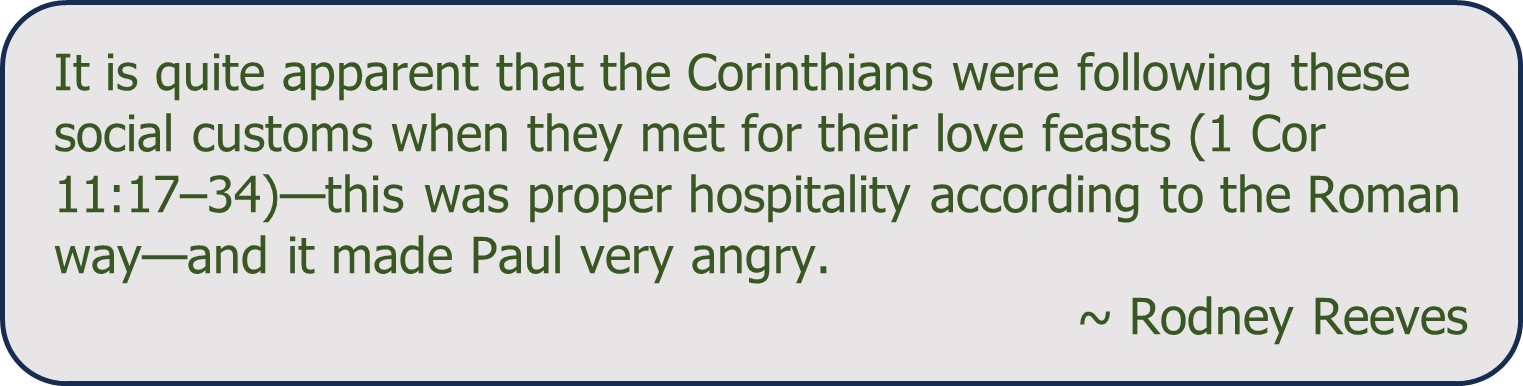
In our next post, we will eagerly explore Sha’ul’s Letters to the Corinthians, starting with 1 Corinthians 12:1 and delving deeper into the topic of Regarding Spiritual Gifts. Stay tuned for more insights and revelations.
Click here for the PDF version.
[1] 1 Corinthians 11:17-34.
 My Heart Is For Israel