
1 Corinthians ~ Part 23
Note: To examine the graphics in this series, click on them for a pop-up version.
As I emphasized in my previous post, we are delving into the profound significance of Sha’ul’s Letters to the Corinthians, a crucial cornerstone of our faith.
Regarding Spiritual Gifts ~ Part 3
Love Is the Greatest Gift
David Sterns aptly characterizes this chapter as a hymn that stands on its own yet seamlessly fits its context; it is the pivotal “Love chapter,” akin to Messianic Jews 11 being the pivotal “faith chapter” and chapter 15 below the pivotal “resurrection chapter.” Love is “the best way of all” (12:31) because it “fulfills the entire Torah” (Romans 13:8–10, Galatians 5:14; see also Mattityahu 22:34–40, Ya’akov (James) 2:8). The Greek word for “Love” is “agapê,” as defined in the New Testament (by passages such as this chapter, Yochanan 3:16, 17:23–26 and 1 Yochanan 2:5–4:21) as giving of and from oneself; Love manifests in acts of benevolence, kindness and mercy in which heart, mind and will are united because they are motivated and empowered by God. Such Love transcends what one can generate of oneself because it originates from God. When such Love is experienced by one person from another, the experience is of God’s Love channeled through that other.
13 1 I may speak in the tongues of men, even angels;
but if I lack Love, I have become merely
blaring brass or a cymbal clanging.
2 I may have the gift of prophecy,
I may fathom all mysteries, know all things,
have all faith—enough to move mountains;
but if I lack Love, I am nothing.
3 I may give away everything that I own,
I may even hand over my body to be burned;
but if I lack Love, I gain nothing.
The manifestations of the gifts of the Ruach may hold value for others, yet they can be devoid of value for the person manifesting them if not accompanied by love. There is no room for pride in possessing a gift from the Ruach. I may give away everything I own, and others may benefit, but if I lack love, I gain nothing. Since such love, as defined above, sets aside all concern with gain, we are confronted with the paradox of love: to reap its benefits, one must relinquish all desire for it. Consider Luke 9:24, Yochanan 12:24–26. The sacrifice of one’s life (give my body) can be the ultimate act of love (Yochanan 15:13; Romans 5:6–8), but it is also possible to make such sacrifice to boast rather than out of love. In this case, nothing is gained.
The Qualities of Love
4 Love is patient and kind, not jealous, not boastful,
5 not proud, rude, or selfish; not easily angered,
and it keeps no record of wrongs.
6 Love does not gloat over other people’s sins
but takes its delight in the truth.
7 Love always bears up, always trusts,
always hopes, always endures.
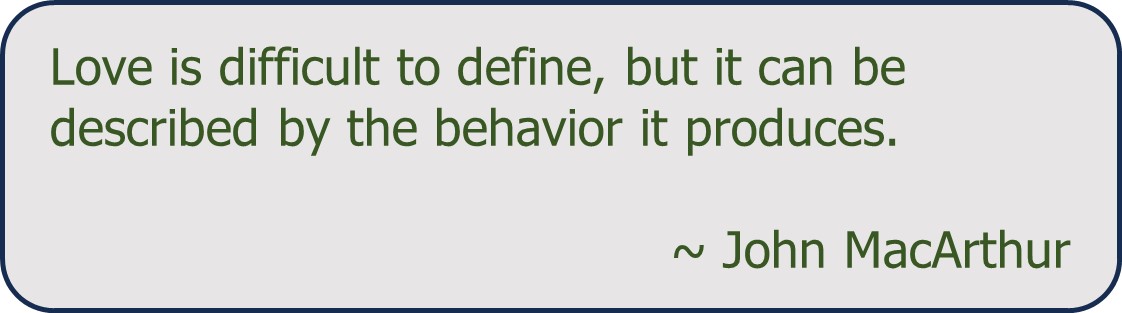
This description of love is not of its outward manifestations but of its inward properties. Sha’ul does not, however, define love as inward feelings because love must act (1 Yochanan 2:5–4:21)—faith works itself out in love (Galatians 5:6). It is precisely because love produces deeds that it fulfills the Torah (Romans 13:8–10).
Love Will Outlast Gifts
8 Love never ends, but prophecies will pass,
tongues will cease, knowledge will pass.
9 For our knowledge is partial, and our prophecy partial;
10 but when the perfect comes, the partial will pass.
11 When I was a child, I spoke like a child,
thought like a child, argued like a child;
now that I have become a man,
I have finished with childish ways.
12 For now, we see obscurely in a mirror,
but then it will be face-to-face.
Now I know partly; then I will know fully,
just as God has fully known me.
13 But for now, three things last—
trust, hope, Love, and the greatest of these is Love.
Of trust, hope, and love, love is greatest because it continues into the next age. Both trust and hope will be fulfilled in eternity and will not remain. This statement concludes a semantic bracket that began in verse 8—“Love never ends.”
14 1 Pursue Love! [1]
Prophecies, tongues, knowledge, and other gifts will pass away when the perfect comes (Yeshua returns; see the last part of 12:8–10). There will be no need then for such gifts; they are for this world only, but what lasts on into the next, says Sha’ul, following a typical rabbinic pattern of comparing the two worlds, is trust (faith), hope, and love. These are all inner spiritual qualities, but because love is an inner state that results in outward action, the greatest of them is love. For this reason, his final advice on the matter is, “Pursue love.”
In our next post, we will eagerly explore Sha’ul’s Letters to the Corinthians, starting with 1 Corinthians 14:1 and delving deeper into the topic of Regarding Spiritual Gifts. Stay tuned for more insights and revelations.
Click here for the PDF version.
[1] 1 Corinthians 13:1-14a.


Amen 🙏
LikeLiked by 1 person
i wrote about Spiritual Gifts a few days ago. 👍🏼🤗 Great Word 👍🏼
LikeLiked by 1 person