1 Corinthians ~ Part 21
Note: To examine the graphics in this series, click on them for a pop-up version.
As I emphasized in my previous post, we are delving into the profound significance of Sha’ul’s Letters to the Corinthians, a crucial cornerstone of our faith.
Regarding Spiritual Gifts
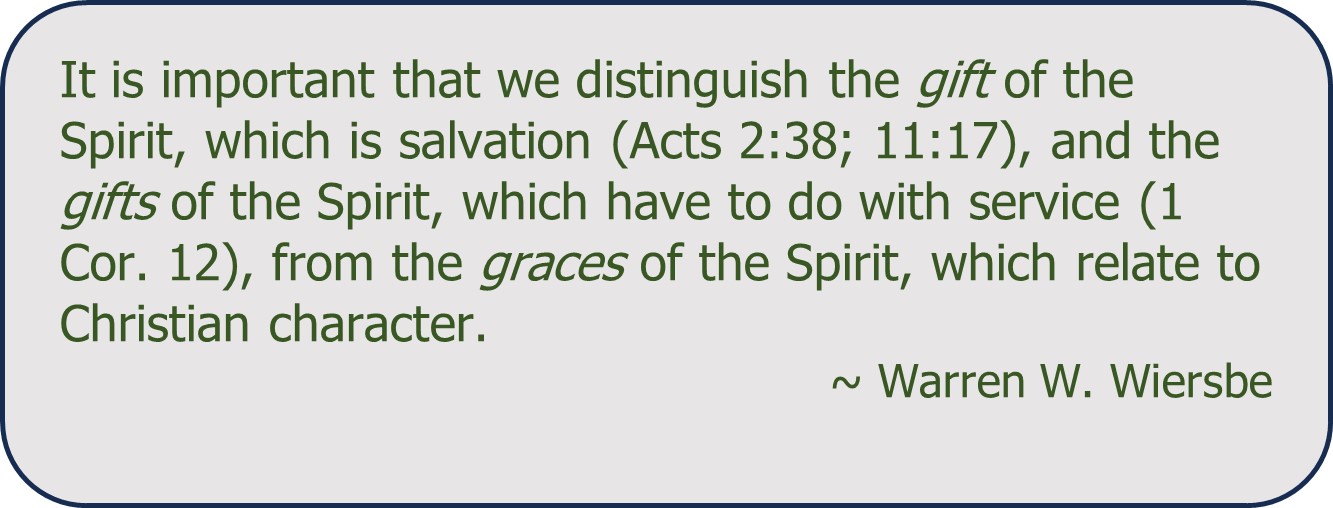
Source of Gifts
12 1 But, brothers, I do not want you to go on being ignorant about the things of the Spirit.
Things of the Spirit, Greek pneumatika, not “spiritual gifts,” as in some translations (eg. ESV & NKJV); although the gifts (Greek charismata, vv. 4, 9, 28, 30, 31) of the Ruach HaKodesh (The Holy Spirit) are the subject of the next three chapters. Sha’ul first deals with the diversity of gifts in the one body of the Messiah (12:1–12:31a), apparently addressing the problem of people taking pride in having this or that gift from the Spirit or feeling inferior because they don’t have it. In the “love chapter” (12:31b–14:1a) he describes the “best way” to live a Messianic life, even better than possessing spiritual gifts. Finally, in 14:1b–40, he addresses the problem the Corinthians had with the disorderly use of the gifts of the Spirit in public worship (see 1 Corinthians 11:2).
2 You know that when you were pagans, no matter how you felt you were being led, you were being led astray to idols which can’t speak at all. 3 Therefore, I want to make it clear to you that no one speaking by the Spirit of God ever says, “Yeshua is cursed!” and no one can say, “Yeshua is Lord,” except by the Ruach HaKodesh.
Idols which can’t speak at all (Psalm 115:4–9), in contrast to speaking by the Spirit of God, by the Ruach HaKodesh, who speaks through human beings in various ways (vv. 7, 10). No one … says, “Yeshua is cursed!”—literally, “Anathema Yeshua!” On curses, see Romans 9:3. Since saying “Yeshua is Lord” is not merely making sounds with one’s mouth, but truly believing, it requires the presence of the Holy Spirit (Romans 8:9); likewise, to curse Yeshua is a sure sign of the absence of the Holy Spirit and the likely presence of some other spirit that opposes God (1 Yochanon 3:24–4:8).
Despite Variety, Same Source
4 Now, there are different kinds of gifts, but the same Spirit gives them. 5 Also, there are different ways of serving, but it is the same Lord being served. 6 And there are different modes of working, but it is the same God working them all in everyone.
The word “Trinity” is never used in the Brit Hadashah, but the elements that led theologians to develop such a concept are seen in passages like this one, where Spirit, Lord, and God refer respectively to the Holy Spirit, Yeshua the Messiah, and the Father. There seems to be less significance in the attribution of the three activities—giving to the Spirit, being served to the Lord, and working to God (the Father)—than in the oversight of all the activities by the same one God.
7 Moreover, to each person is given the particular manifestation of the Spirit that will be for the common good.

The particular manifestation of the Spirit that each person receives is due not to his own merit but to the Spirit, … distributing to each person as he chooses, not to provide ground for pride but for the common good.
8 To one, through the Spirit, is given a word of wisdom; to another, a word of knowledge, in accordance with the same Spirit; 9 to another, faith, by the same Spirit; and to another, gifts of healing, by the one Spirit; 10 to another, the working of miracles; to another, prophecy; to another, the ability to judge between spirits; to another, the ability to speak in different kinds of tongues; and to yet another, the ability to interpret tongues. 11 One and the same Spirit is at work in all these things, distributing to each person as he chooses.
David Sterns’s Definition of Sha’ul’s List of Spiritual Gifts
Body Has Many Members
12 For just as the body is one but has many parts; and all the parts of the body, though many, constitute one body; so it is with the Messiah. 13 For it was by one Spirit that we were all immersed into one body, whether Jews or Gentiles, slaves or free; and we were all given the one Spirit to drink. 14 For indeed, the body is not one part but many. [1]
To illustrate that individual Believers become identified as one body of Yeshua (i.e., as the unified church), Sha’ul borrowed imagery from the practice of dying various cloths by immersing them in the same dye vat. All Believers are immersed (baptized) into one body and are made to drink of one Spirit.
In our next post, we will eagerly explore Sha’ul’s Letters to the Corinthians, starting with 1 Corinthians 12:15 and delving deeper into the topic of Regarding Spiritual Gifts. Stay tuned for more insights and revelations.
Click here for the PDF version.
[1] 1 Corinthians 12:12–14.
 My Heart Is For Israel
Amen 🙏🤗
LikeLike